
New NSF Award: Generative Modeling of Atomic Disorder in High-Entropy Oxide Materials
A $578,383 NSF project will develop AI-guided methods to design more stable, energy-dense battery cathodes.
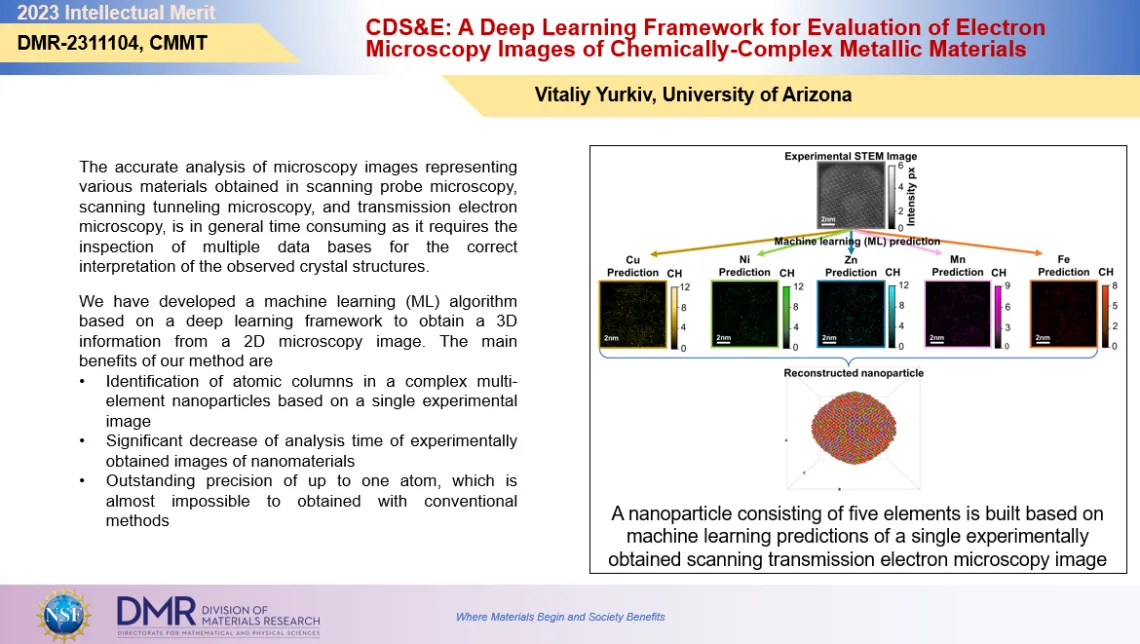
U.S. National Science Foundation-supported research.
The U.S. National Science Foundation has awarded $578,383 to the University of Arizona for a new three-year project led by Vitaliy Yurkiv: CDS&E: Generative Modeling of Atomic Disorder in High-Entropy Oxide Materials.
Project overview
High-entropy oxide cathodes contain several metal elements within the same crystal structure. This chemical complexity can improve battery performance, but the enormous number of possible local atomic arrangements makes it difficult to identify structures that are stable, energy-dense, and resistant to degradation.
The project will combine density functional theory, high-performance computing, and Transformer-based generative models. By representing each atomic site as a token in a sequence, the models will learn the “occupancy grammar” of disordered crystals, generate candidate structures, and identify short-range ordering patterns that guide the design of more stable cathodes.
Why it matters
Better cathode materials are essential for electric transportation, aerospace systems, portable electronics, and grid-scale energy storage. The new framework will accelerate computational materials discovery while advancing fundamental understanding of atomic disorder in high-entropy materials.
Education and open science
Graduate and undergraduate researchers will receive interdisciplinary training in first-principles modeling, machine learning, battery materials science, and scientific computing. The project will also share open-source software, curated datasets, tutorials, and online demonstrations for the broader research community.
Award details: NSF Award 2602117 · Division of Materials Research · August 1, 2026–July 31, 2029 · $578,383.